1October 1503Milestone
Florence: Leonardo works on the portrait of Lisa del Giocondo
Basilica of the Santissima Annunziata, Piazza della Santissima Annunziata, Florence, Italy
A marginal note in a book, written by Agostino Vespucci in October 1503 and rediscovered in Heidelberg in 2005, proves that Leonardo da Vinci was working on a portrait of Lisa del Giocondo at that time.
The painting was not finished in one season: Leonardo would retouch it for years, perhaps until 1516-1517.
22 May 1519Transition
Death of Leonardo in Amboise: the painting enters the royal collections
Château du Clos Lucé, 2 rue du Clos Lucé, Amboise, France
Invited by Francis I in 1516, Leonardo brought the Mona Lisa with him, according to tradition. He died at the Clos Lucé on May 2, 1519.
The painting then entered the French royal collections, where it would remain for three centuries before becoming a national asset.
31797Transition
The Louvre exhibits it permanently: a national asset
Louvre Museum, rue de Rivoli, Paris, France
Since 1797, the Mona Lisa has been on permanent display at the Louvre. The painting's status changed: it no longer belonged to the king, but to the nation.
A brief stay in Napoleon's bedroom at the Tuileries did nothing to alter its return to the museum.
41859 - 1869Recognition
The Romantics turn it into a myth
Louvre Museum, rue de Rivoli, Paris, France
In the mid-19th century, the Mona Lisa ceased to be just one painting among many and became a literary myth.
- 1859: Théophile Gautier described her as a "sphinx of beauty" with a mysterious smile
- 1869: Walter Pater turned her into an almost immemorial figure, older than the rocks among which she sits
Respect was earned. The general public was still to follow.
522 Aug 1911Turning Point
The Theft of the Mona Lisa: The Empty Wall of the Salon Carré
Salon Carré, Louvre Museum, rue de Rivoli, Paris, France
On August 22, 1911, the painter Louis Béroud arrived at the Salon Carré to copy the Mona Lisa and found only the wall. The rooms were evacuated, the doors closed.
- The thief, Vincenzo Peruggia, was a former employee of the museum
- About sixty police officers and the criminologist Alphonse Bertillon found nothing
- The scandal targeted the Louvre's negligence and made headlines around the world
The painting, previously known mainly to art enthusiasts, became the most famous work in the world.
67 Sept 1911Challenge
The Investigation Goes Astray: Apollinaire Imprisoned, Picasso Questioned
La Santé Prison, 42 rue de la Santé, Paris, France
The police follow a secondary lead: Iberian statuettes stolen from the Louvre by Géry Pieret, Apollinaire's former secretary.
Guillaume Apollinaire is arrested on September 7, 1911, and spends about a week at La Santé prison. Picasso, who had purchased one of the statuettes, is interrogated. Both are eventually cleared of the Mona Lisa case.
When everyone is a suspect, it means the artwork has become larger than the museum itself.
7December 1913 - January 1914Milestone
Found in Florence, Back at the Louvre
Uffizi Gallery, Piazzale degli Uffizi 6, Florence, Italy
Two years after the theft, Peruggia offers the painting to the antique dealer Alfredo Geri in Florence. Geri alerts the director of the Uffizi, Giovanni Poggi, who confirms that it is indeed the original.
The thief is arrested, the painting is exhibited in Italy, and then returns to the Louvre on January 4, 1914, twenty-eight months after its disappearance.
Its absence has transformed it: it returns as an icon.
8March 1920Turning Point
Duchamp draws a mustache on her: L.H.O.O.Q.
Avenue Charles-Floquet, Paris 7e, Paris, France
In the autumn of 1919, Marcel Duchamp, then staying at Picabia's home in Paris, draws a mustache and a goatee on a postcard of the Mona Lisa.
He titles it L.H.O.O.Q., the French pronunciation of which is intentionally ribald. The image appears in March 1920 in the 12th issue of the magazine 391.
The world's most famous painting becomes a material: it can be subverted, therefore it is alive.
The gesture would set a precedent: Dalí would follow suit in a self-portrait as the Mona Lisa, a few decades later.
925 Jun 1932Legend
The Valfierno Legend: Six Copies and a Fake Plot
Curtis Publishing Company Building, Sixth and Walnut Streets, Philadelphia, United States
In the Saturday Evening Post of June 25, 1932, Karl Decker tells the story allegedly shared with him by a certain Eduardo de Valfierno: the 1911 theft was merely a means to sell six copies to buyers convinced they possessed the original.
The story is compelling, but nothing corroborates it: no copies have ever been found, details are inaccurate, and Valfierno's very existence is not established.
Proof that fame also attracts fables.
1028 Aug 1939Challenge
1939 Evacuation: The First Safeguarding
Louvre Museum, rue de Rivoli, Paris, France
On the eve of the war, the painting left the Louvre on August 28, 1939. It was successively hidden in Amboise, at the Loc-Dieu Abbey, at the Château de Chambord, and then at the Ingres Museum in Montauban.
The Mona Lisa thus escaped Nazi looting. It was the first time it was hidden to protect it from its own value.
1112 Jun 1950Recognition
Nat King Cole sings "Mona Lisa"
Capitol Studios, 5515 Melrose Avenue, Hollywood, United States
The song "Mona Lisa", from the film Captain Carey, U.S.A. (1949), was recorded by Nat King Cole on March 11, 1950, and released on June 12, 1950.
It remained five weeks at number one on the Billboard chart and the song won the Oscar.
The painting was no longer just seen: it was sung all over the world.
1230 Dec 1956Challenge
The 1956 Stone: Bulletproof Glass Becomes Essential
Louvre Museum, rue de Rivoli, Paris, France
On December 30, 1956, Ugo Ungaza Villegas, a Bolivian man, threw a stone at the painting. The glass shattered and a pigment chip broke off near the left elbow. The painting was subsequently restored.
Since then, bulletproof glass has protected the work. This was the first moment when fame came at a physical cost.
139 Jan 1963 - 3 Feb 1963Milestone
Washington 1963: The American Tour Begins
National Gallery of Art, Constitution Avenue NW, Washington, United States
In late December 1962, the Mona Lisa left France aboard the ocean liner SS France. It was exhibited at the National Gallery of Art from January 9 to February 3, 1963, in the center of the West Sculpture Hall, on a panel draped in red velvet.
- 518,525 visitors in less than a month
- Insurance value estimated at $100 million, a Guinness World Record
- No insurance policy taken out: the sum was invested in security
For the first time, a painting had a price that could not be paid.
147 Feb 1963 - 1 Mar 1963Recognition
New York 1963: over a million visitors in one month
The Metropolitan Museum of Art, 1000 Fifth Avenue, New York, United States
On February 7, 1963, the Mona Lisa was presented to the public at The Metropolitan Museum of Art. Over one million visitors came to see it in a single month, according to the museum.
It was the height of fame: people came to see an event rather than just a painting.
15March 1963Recognition
Warhol Multiplies It: Thirty Are Better than One
The Metropolitan Museum of Art, 1000 Fifth Avenue, New York, United States
Using images from the Metropolitan Museum brochure, Andy Warhol silkscreened the Mona Lisa in a grid of thirty: Thirty Are Better than One.
The repetition transforms it almost into wallpaper. Following Duchamp, Warhol treats it as a mass-market product.
1620 Apr 1974 - 10 Jun 1974Challenge
Tokyo 1974: Red Paint on the Showcase
Tokyo National Museum, 13-9 Uenokōen, Taitō, Tokyo, Japan
The Mona Lisa is exhibited at the Tokyo National Museum from April 20 to June 10, 1974, before traveling to Moscow.
In the early days (April 20 or 21, depending on sources), a young disabled woman sprays red paint on the glass to protest the museum's lack of accessibility.
Its fame has turned it into a platform: it is attacked to draw attention to other causes.
176 Apr 2005Transition
The Salle des États: A Climate-Controlled Vault
Salle des États, Louvre Museum, rue de Rivoli, Paris, France
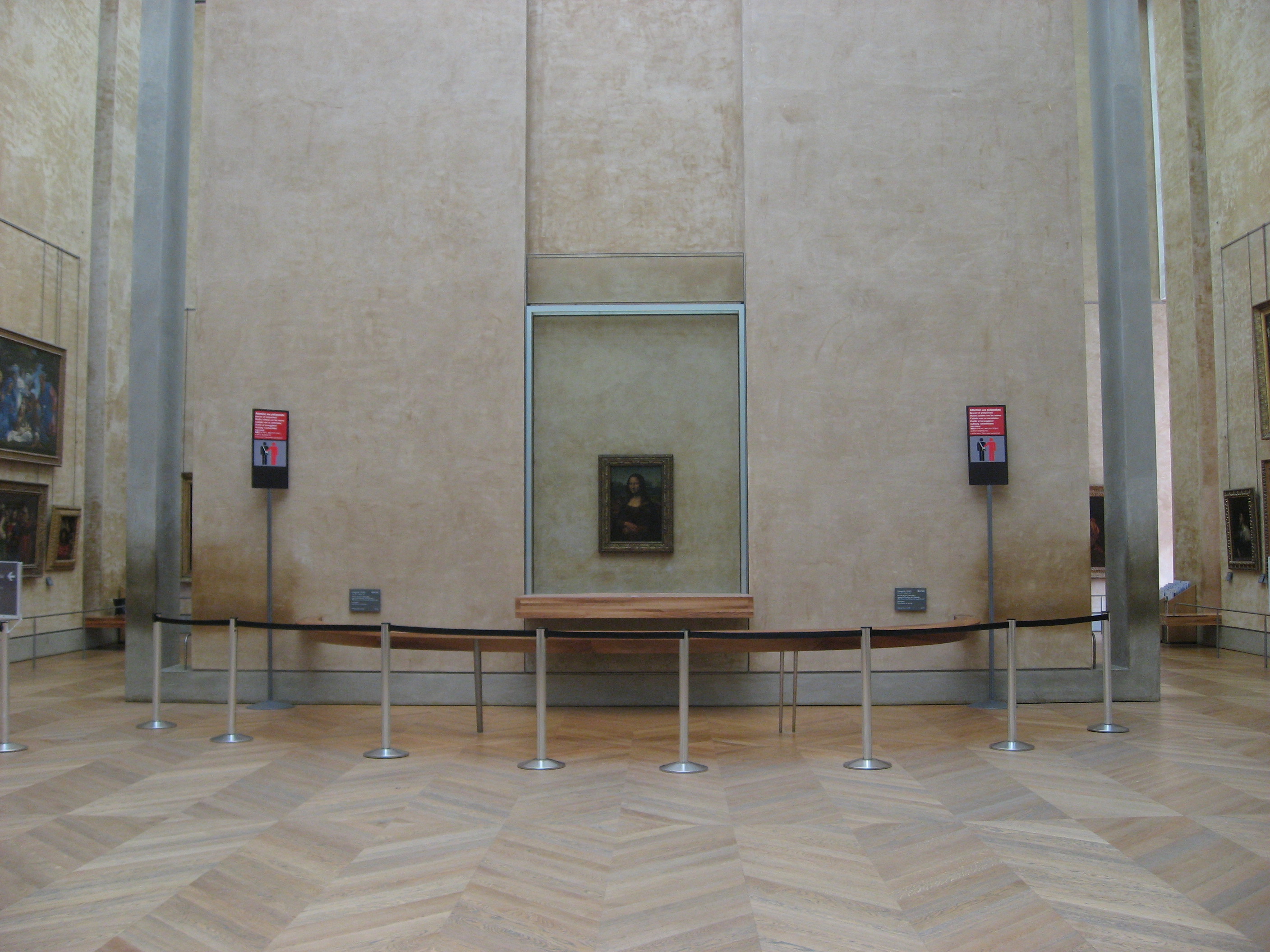
After maintenance work and analysis, the Mona Lisa was transferred on April 6, 2005, to the Salle des États, in a custom-made, climate-controlled enclosure behind bulletproof glass.
- Approximately 10.2 million people see it every year (2019 data)
- After the queue, about 30 seconds remain to stand before the painting
Safe and sound, but further and further away.
182 Aug 2009 - 28 Jan 2024Challenge
The Era of Attacks: Cup, Cake, Soup
Salle des États, Louvre Museum, rue de Rivoli, Paris, France
Behind its glass, the Mona Lisa becomes the ideal target for protest.
- August 2, 2009: a Russian woman throws a ceramic cup at the display case
- May 29, 2022: a man disguised as an elderly lady in a wheelchair smears a cake, in the name of the climate
- January 28, 2024: two activists from Riposte Alimentaire throw pumpkin soup, the room is evacuated
The painting is never touched. It has become a medium for messages, protected by what conceals it.
1928 Jan 2025 - 1 May 2026Transition
A room of her own: from the announcement to the choice of architects
Salle des États, Louvre Museum, rue de Rivoli, Paris, France
In front of the painting, on January 28, 2025, Emmanuel Macron launched the Louvre's Nouvelle Renaissance project.
- A new entrance, on the side of the Perrault Colonnade
- A dedicated room for the Mona Lisa, with independent access and a specific ticket
- New galleries under the Cour Carrée, for works announced to last until 2031
In May 2026, a jury selected the firms Studios Architecture and Selldorf Architects. The project plans for a dedicated path for the Mona Lisa, with no opening schedule announced to date.
Respect, glory, then showcase: the next step would be a journey where she would be alone with her visitors.