14 Jul 1776Milestone
Congress Adopts the Text — Not Yet the Nation
Pennsylvania State House (Independence Hall), Philadelphia, Pennsylvania, USA
The Second Continental Congress votes to adopt the text of the Declaration of Independence. This is a crucial step, although the colony of New York still abstains. John Hancock, as President, and Secretary Charles Thomson are the only ones to affix their signatures that day. The text is immediately handed over to printer John Dunlap for rapid distribution, marking the beginning of a new era.
25 Jul 1776Milestone
200 copies, one night, a nation to convince
Philadelphia, Pennsylvania, USA
The Dunlap Broadsides, these first printed versions of the Declaration, are distributed with paramount urgency. They reach colonial assemblies, committees of safety, and military commanders, carrying a revolutionary message. The only visible signature is the printed one of Hancock, highlighting the haste to spread the word even before the formal signing of the official document. This marks the beginning of communicating independence to the population.
38 Jul 1776Legend
First Public Readings, Philadelphia in Celebration
Independence Square, Philadelphia, Pennsylvania, USA
Colonel John Nixon performs the first official public reading of the Declaration on Independence Square in Philadelphia, marking a moment of intense fervor. Similar readings take place in Trenton and Easton, spreading the message of liberty. Popular tradition claims that the Liberty Bell rang for the occasion, a powerful symbol even if historical evidence is lacking to confirm this legend. The popular enthusiasm is palpable.
49 Jul 1776Turning Point
Washington galvanizes his troops in New York
Bowling Green, New York City, New York, USA
George Washington orders the reading of the Declaration to his troops in New York, an act intended to restore courage to soldiers whose morale is at an all-time low after several setbacks. This key moment aims to anchor the cause of independence in the minds of the combatants. A few hours after this inspiring reading, popular fervor rises to a new level.
59 Jul 1776Turning Point
The Leaden King Becomes 42,088 Bullets
Bowling Green, New York City, New York, USA
In an act of symbolic and concrete rebellion, an enraged crowd topples the equestrian statue of George III at Bowling Green. The 4,000 pounds of gilded lead are transformed into an instrument of war: the statue is melted down in Litchfield, Connecticut, to produce 42,088 bullets for the Continental Army. This event illustrates the radical transition from loyalty to armed resistance.
612 Jul 1776Challenge
British Threat on the Horizon: A Fleet Arrives in New York
New York Harbor, New York, USA
As the euphoria of independence spreads through Philadelphia, an imposing British fleet appears in New York Harbor, casting a menacing shadow over the celebrations. These warships, visible from Manhattan, serve as a reminder of the harsh reality of war. Facing this professional military power, Washington and his 19,000 men, often poorly equipped, prepare for an inevitable confrontation. The hour of battle approaches.
715 Jul 1776Turning Point
New York Finally Joins — Unanimity Was a Lie
New York City, New York, USA
Eleven days after the adoption of the text, the New York State Convention finally ratifies the Declaration. This late accession reveals that the 'unanimous declaration of the thirteen States' was, in reality, a myth constructed a posteriori. New York's initial abstention highlights the divisions and hesitations that preceded unity, underscoring the complexity of the process of forming the union.
819 Jul 1776Milestone
Congress orders the official parchment
Pennsylvania State House (Independence Hall), Philadelphia, Pennsylvania, USA
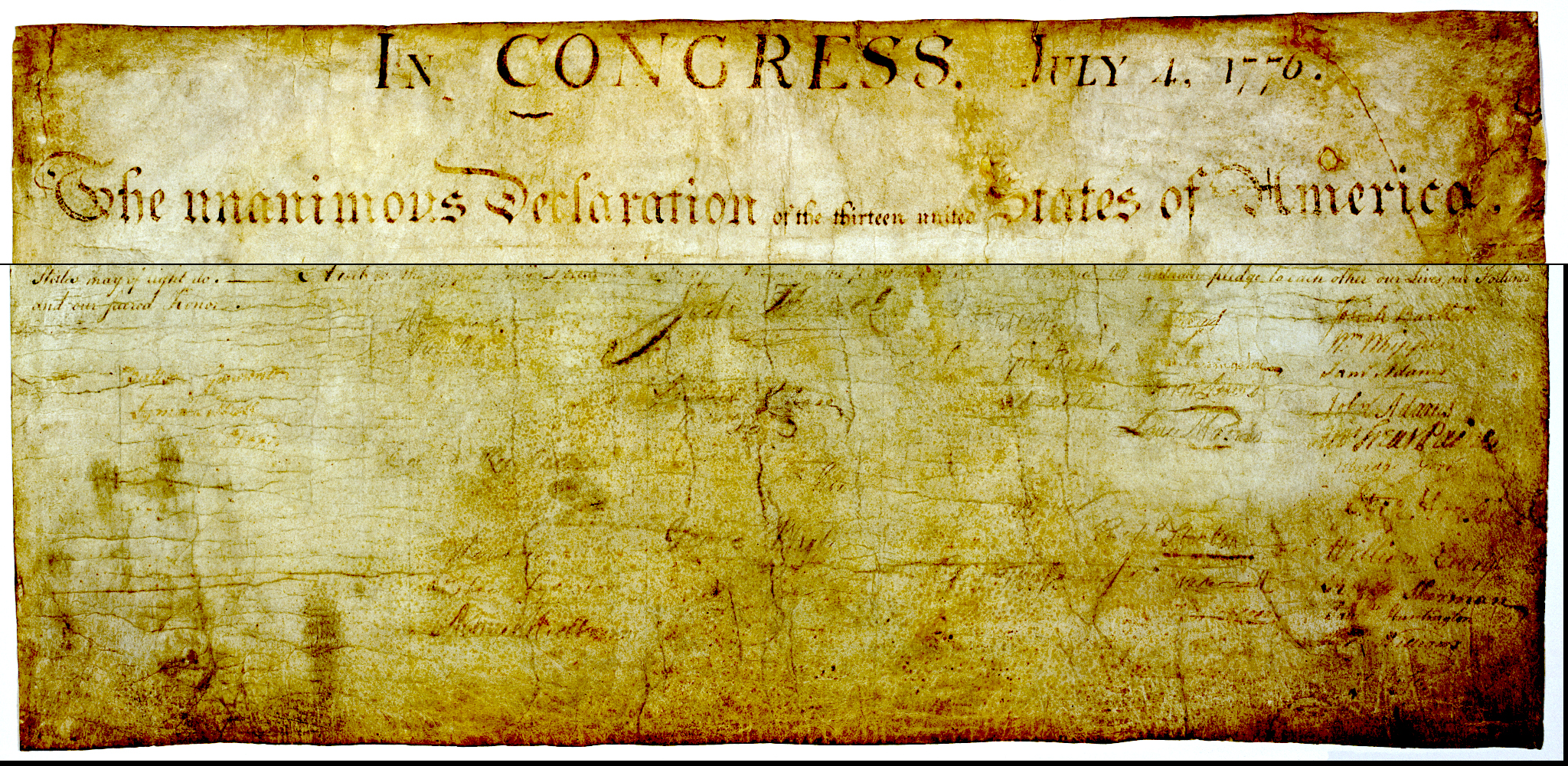
The Continental Congress takes a crucial decision: the Declaration must be engrossed on parchment in a large format. This document, which will become the signed original, is titled 'The unanimous declaration of the thirteen united States of America', reinforcing the idea of a now-established unity. The task is entrusted to Timothy Matlack, and this step paves the way for the long-awaited collective signing by the delegates, a solemn act of commitment.
922 Jul 1776
The King's Army Camps on Staten Island
Sten Island, New York, USA
British reinforcements complete their landing on Staten Island: 32,000 professional soldiers and Hessian mercenaries face Washington's 19,000 ill-equipped men. The attack on Manhattan is imminent. In Philadelphia, the delegates preparing to sign the parchment know they are potentially signing their own death warrants — treason against the Crown is punishable by hanging.
102 Aug 1776Milestone
They sign a text adopted without them
Pennsylvania State House (Independence Hall), Philadelphia, Pennsylvania, USA
Twenty-nine days after its adoption, the Declaration of Independence is finally signed by the majority of the delegates. John Hancock places his iconic signature in the center. It is notable that some signatories were not present on July 4th, while others present that day would never sign. Even more surprising, seven new delegates, who arrived after July 4th, also append their names, illustrating the evolving nature of this founding act and the progressive commitment of the colonies.