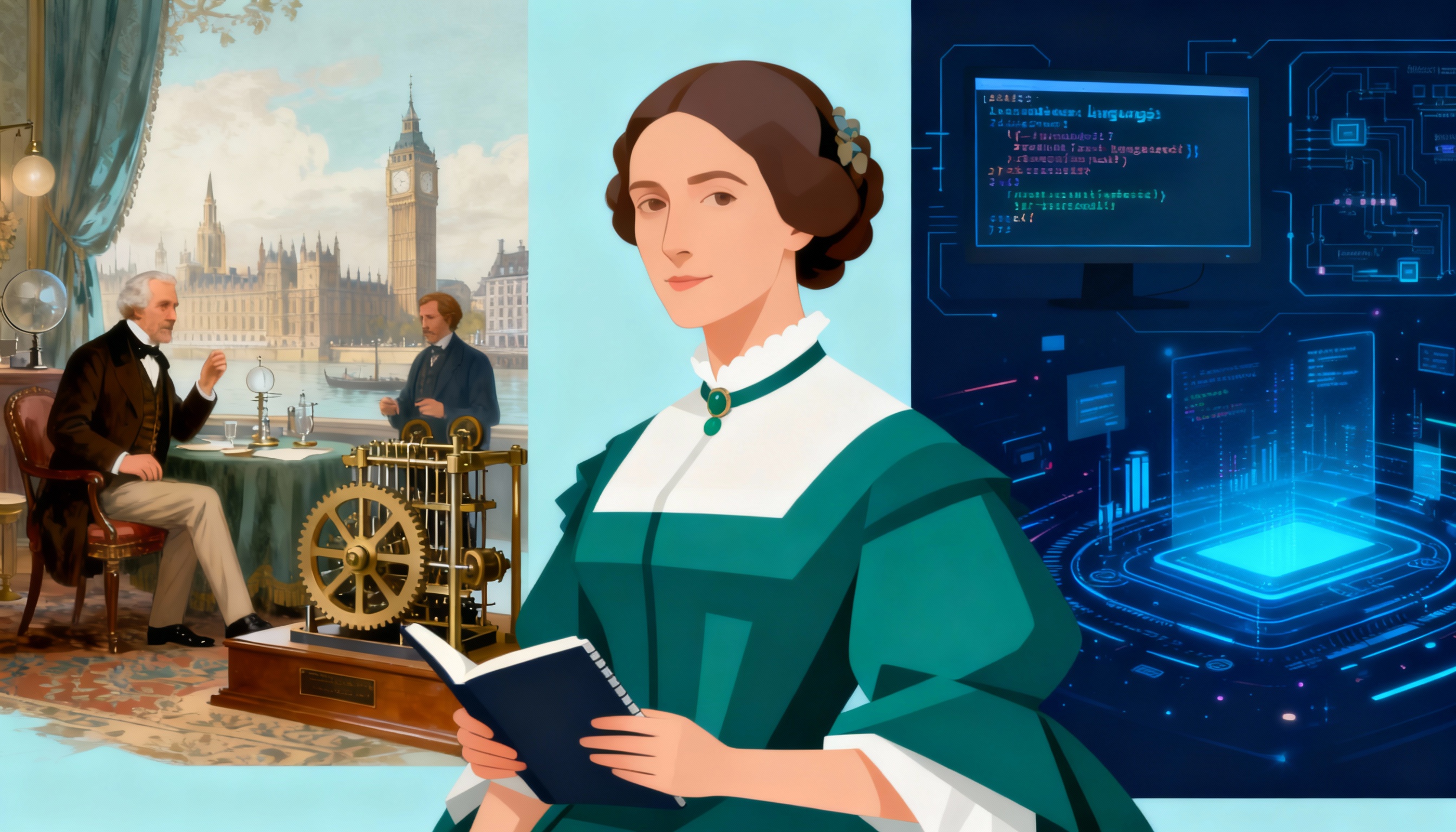
Discover Ada Lovelace's extraordinary life, from her privileged scientific education to her groundbreaking collaboration with Charles Babbage. This journey unveils how her visionary algorithms laid the foundation for modern computing, leaving an indelible mark on the digital world.
The birth of Augusta Ada Byron at Piccadilly Terrace, London, marks the beginning of an extraordinary life. Daughter of the famous poet Lord Byron and Anne Isabella Milbanke, Ada received a rigorous scientific education, highly unusual for a young woman of her time. This early training in mathematics and science would be crucial for her career.
21 Jan 1830
Intensive Mathematical Training
Ealing, England
During the 1820s-1830s, in family estates such as Ealing, England, Ada benefited from an intensive education in mathematics and science, driven by her mother. This rigorous training provided her with the necessary skills to grasp the complex concepts of computing machines, a rare privilege for a woman of her time.
35 Jun 1833
Meeting with Charles Babbage
Charles Babbage's Residence, London, England
In June 1833, during a social salon in London, Ada Lovelace had a life-changing encounter: meeting Charles Babbage. She was fascinated by his 'Difference Engine', his calculating machine. This meeting opened the door to an intellectual collaboration that would immerse her in the heart of the mechanical innovations of the era.
41 Aug 1843
Vision of Universal Machines
London, England
It was also in 1843, in London, that Ada Lovelace presented her prophetic vision of machines. She understood that the Analytical Engine could go beyond numerical calculations to manipulate symbols of any kind, paving the way for the creation of music, images, and much more. This anticipation of the concept of the general-purpose computer is a major contribution to computer theory.
51 Aug 1843
Ada Lovelace's Notes and the First Program
Taylor's Scientific Memoirs, London, England
In 1843, in the journal Taylor's Scientific Memoirs in London, Ada Lovelace published her translation of Menabrea's article on Babbage's Analytical Engine, enriched with her own 'Notes' signed A.A.L. Note G describes a detailed algorithm for calculating Bernoulli numbers, laying the foundations for what is recognized today as the first computer program. This visionary work transformed the abstract concept of the machine into a programmable entity.
627 Nov 1852
Death of Ada Lovelace and relative obscurity
Marylebone, London, England
Ada Lovelace passed away on November 27, 1852, in Marylebone, London, at only 36 years old. She was buried alongside her father in Hucknall, Nottinghamshire. Her death marked the beginning of a period where her pioneering contributions to computing fell into relative obscurity, as her work was not yet fully recognized by history.
71 Jan 1970
Rediscovery of her work
Mountain View, California, United States
Starting in the mid-20th century, a concerted effort by historians and curators, notably at the Computer History Museum in Mountain View, California, led to the rediscovery of Ada Lovelace's work. Exhibitions such as 'Thinking Big: Ada, Countess of Lovelace' highlighted her 'Notes' and her understanding of the Analytical Engine, reinstating her as the undisputed pioneer of programming.
81 Jan 1979
Creation of the Ada Programming Language
La Celle Saint-Cloud, France
Between 1977 and 1983, the United States Department of Defense commissioned a French team led by Jean Ichbiah to design a programming language for embedded systems and critical applications named Ada, in tribute to Ada Lovelace. Its standardization by ANSI and ISO in 1983 definitively anchored its name in modern software engineering, recognizing its fundamental impact.
91 Jan 1981
Creation of the Ada Lovelace Award
Washington, D.C., United States
In 1981, the Association for Women in Computing (AWC), based in Washington, D.C., instituted the Ada Lovelace Award. This prize is awarded annually to individuals who distinguish themselves through exceptional technical achievements and their commitment to advancing women in the field of computing. It establishes Ada Lovelace as an institutional emblem and a source of inspiration for future generations.
1024 Mar 2009
Launch of Ada Lovelace Day
London, United Kingdom
On March 24, 2009, the organization Finding Ada (later associated with the Royal Institution) in London, United Kingdom, launched Ada Lovelace Day. This annual day aims to celebrate women in STEM (science, technology, engineering, and mathematics). It contributes to popularizing Ada Lovelace's history among the general public and technological communities, permanently embedding her image in digital culture and inspiring many women.
Pour aller plus loin
Liens sponsorisés
L'incroyable destin de Ada Lovelace, pionnière de l'informatique
Découvrir
Ada Lovelace - Petite & GRANDE
Portrait d'Ada passionnée de Math et son évolution !
Découvrir
En tant que partenaire, nous pouvons percevoir une commission sur les achats qualifiés.